Your SDR team logs into three tools every morning. One dashboard shows intent data, another holds the enriched contact list, and a third fires the sequences. Between those tabs live four spreadsheets, a Slack channel named #prospecting-chaos, and a weekly meeting where someone asks why pipeline coverage dropped again.
This is what "using AI" looks like at most B2B companies in 2026. Tools everywhere, workflow nowhere.
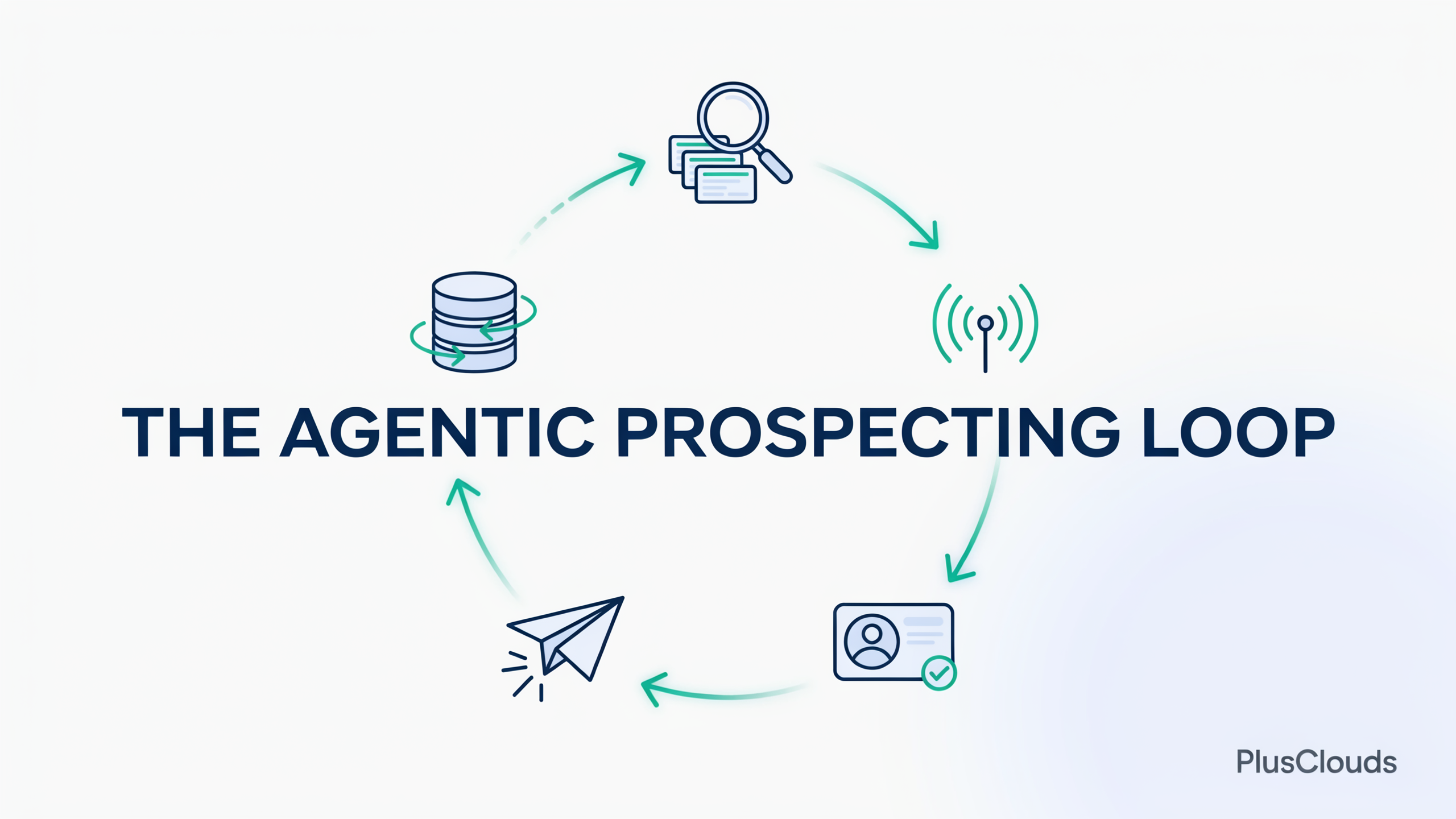
The distinction matters more than it did a year ago. Adoption is no longer the differentiator: research on the state of AI in sales prospecting shows that 88% of companies now use AI for at least one sales activity. When nearly everyone has AI somewhere in the stack, the advantage shifts to teams that wire those tools into a single autonomous loop, one that identifies accounts, detects buying signals, enriches and verifies contacts, executes outreach, and updates the CRM without a human pushing data between stages.
That loop is what people mean by agentic prospecting: software agents that own discrete stages of the outbound process, hand off to each other through defined triggers, and only escalate to humans when a reply lands or a rule breaks. This guide walks through the five stages of that loop, the configuration decisions at each stage, and the four metrics that tell you whether the machine is actually producing pipeline.
Table of Contents
- Key Takeaways
- Why "Using AI Tools" Is Not the Same as Running an AI Workflow
- The Five Stages of an Agentic Prospecting Loop (and Where Human Gaps Are Costing You Pipeline)
- Stage 1: Account Identification, How LeadOcean's AI Match Engine Builds a Daily Target Queue
- Stage 2: Buying-Signal Detection, Configuring Real-Time Triggers That Surface In-Market Accounts
- Stage 3: Contact Enrichment and Verification, Ensuring Data Quality Before Eaglet Touches an Account
- Stage 4: Personalized Sequence Execution, How Eaglet Writes and Fires Multichannel Outreach Automatically
- Stage 5: CRM Sync and Loop Closure, Auto-Updating HubSpot and Salesforce Without Manual Entry
- How to Measure the Workflow: The Four Metrics That Tell You Whether Your Agentic Loop Is Actually Working
- Assembling Your Autonomous Prospecting Loop
Key Takeaways
- Agentic prospecting means software agents owning each outbound stage with automatic handoffs, not a collection of AI tools with humans moving data between them.
- The loop has five stages: account identification, signal detection, enrichment and verification, sequence execution, and CRM sync, and each stage closes a specific human failure mode.
- LeadOcean's AI Match Engine replaces quarterly list builds with a daily refreshed target queue; Eaglet by PlusClouds executes personalized multichannel sequences and syncs outcomes to HubSpot or Salesforce.
- Tier your signal responses: Tier 1 signals should trigger outreach within four hours, not days.
- Measure four things: signal-to-contact latency, verified-contact rate, reply rate by signal tier, and CRM completeness. Everything else is downstream of these.
Why "Using AI Tools" Is Not the Same as Running an AI Workflow
Here is the problem with the piecemeal approach: every manual handoff between tools is a place where speed dies and data rots.
An account shows buying intent on Monday. Your intent tool flags it. Nobody triages the alert until Thursday. By the time an SDR researches the account, finds a decision-maker, and drafts an email, the signal is five days old and your competitor has already booked the intro call. We covered this timing problem in depth in The 48-Hour Activation Window: the value of a buying signal decays fast, and most of it is gone within two days.
A workflow, as opposed to a tool collection, has three properties:
- Automatic handoffs. When stage two finishes, stage three starts without a human clicking anything.
- A single source of truth. Every stage reads from and writes to the same record, so enrichment data, signal history, and outreach status live on one account object.
- Defined failure behavior. If an email bounces or an enrichment call returns nothing, the system routes the account to a review queue instead of silently dropping it.
Most teams have fragments of all three. Almost none have them connected end to end. That connection is the actual engineering work, and it is what the rest of this article covers.
The Five Stages of an Agentic Prospecting Loop (and Where Human Gaps Are Costing You Pipeline)
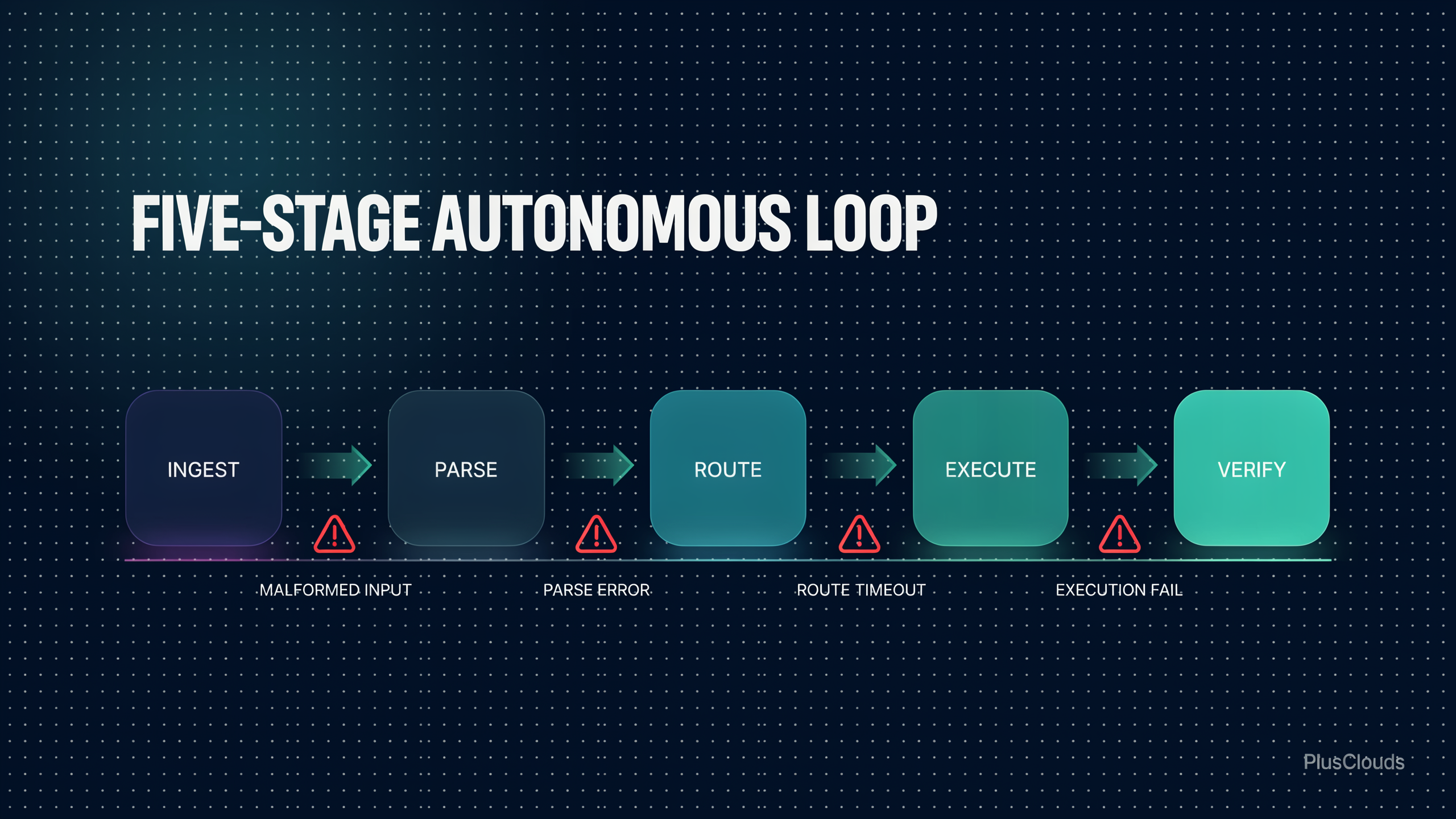
The loop has five stages. Each one maps to a specific failure mode when humans sit in the middle of it.
| Stage | What Happens | Failure Mode When Manual |
|---|---|---|
| 1. Account identification | Build a daily queue of accounts matching your ICP | Stale target lists, ICP drift |
| 2. Signal detection | Surface in-market accounts in real time | Signals triaged days late |
| 3. Enrichment and verification | Attach verified decision-maker contacts | Bounces, wrong personas |
| 4. Sequence execution | Personalized multichannel outreach fires | One-size-fits-all templates |
| 5. CRM sync and loop closure | Outcomes write back automatically | Reps stop trusting the CRM |
Two things to keep in mind as we go through each stage. First, the loop is a cycle, not a line: CRM outcomes in stage five feed back into stage one, refining your ICP filters with every closed deal. Second, "no human input" does not mean "no human oversight." You set the rules, thresholds, and guardrails. The agents execute inside them.
Stage 1: Account Identification, How LeadOcean's AI Match Engine Builds a Daily Target Queue
Everything starts with a target queue, and the quality of everything downstream depends on it.
The traditional approach is a quarterly list build: someone exports a filtered view from a data provider, drops it in a sheet, and the team works it until it runs dry. By week six, half the accounts have changed hiring plans, funding status, or tech stack, and nobody noticed.
LeadOcean replaces the quarterly list build with a standing query. Its AI Match Engine searches a database of over 1.8 billion companies against your Ideal Customer Profile and produces a refreshed queue of matching accounts every day. The configuration work is defining that ICP precisely enough for a machine to apply it:
- Firmographic filters: industry codes, employee bands, revenue ranges, geography.
- Technographic filters: the tools a company already runs, which often predict readiness for yours.
- Behavioral filters: funding events, hiring surges in relevant roles, and engagement history.
A practical starting point: pull your last 20 closed-won deals, extract the firmographic and technographic attributes they share, and encode those as your match criteria. Then let the engine run daily and compare new matches against your closed-won profile monthly. If you want a deeper treatment of this stage, we broke down the full filter design process in The ICP-to-Pipeline Flywheel.
The human gap this closes: ICP drift. When identification is manual, your target list quietly stops matching who actually buys from you. A daily automated match against a periodically refreshed profile keeps that from happening.
Stage 2: Buying-Signal Detection, Configuring Real-Time Triggers That Surface In-Market Accounts
A queue of matching accounts tells you who could buy. Signals tell you who is buying now.
The signals worth wiring into your loop fall into four categories:
- First-party signals: pricing page visits, repeat returns to comparison content, demo video completions on your own site.
- Third-party intent: topic surges across publisher networks indicating an account is researching your category.
- Technographic change signals: a company installing a complementary or competitive tool, often visible within days of the decision.
- Hiring signals: open roles that imply budget, such as a company hiring its first RevOps lead right before buying RevOps tooling.
The configuration decision that matters most is trigger priority. Not all signals deserve the same response. Set up tiers:
TIER 1 (respond within 4 hours):  pricing page visit + ICP match
                                  competitor tool installed + ICP match
TIER 2 (respond within 24 hours): topic intent surge + hiring signal
TIER 3 (nurture only):            content engagement, no ICP match
Tier 1 accounts skip the queue and enter the loop immediately. Tier 3 accounts go into a slower nurture sequence or get dropped. Without tiers, your system treats every signal as urgent, your outreach volume spikes, and reply rates collapse.
The human gap this closes: triage latency. An agent watching signal feeds triages in seconds what a human SDR triages at 9 AM the next day, if at all. For a fuller taxonomy of signal types and how they convert, see B2B Intent Data Explained.
Stage 3: Contact Enrichment and Verification, Ensuring Data Quality Before Eaglet Touches an Account
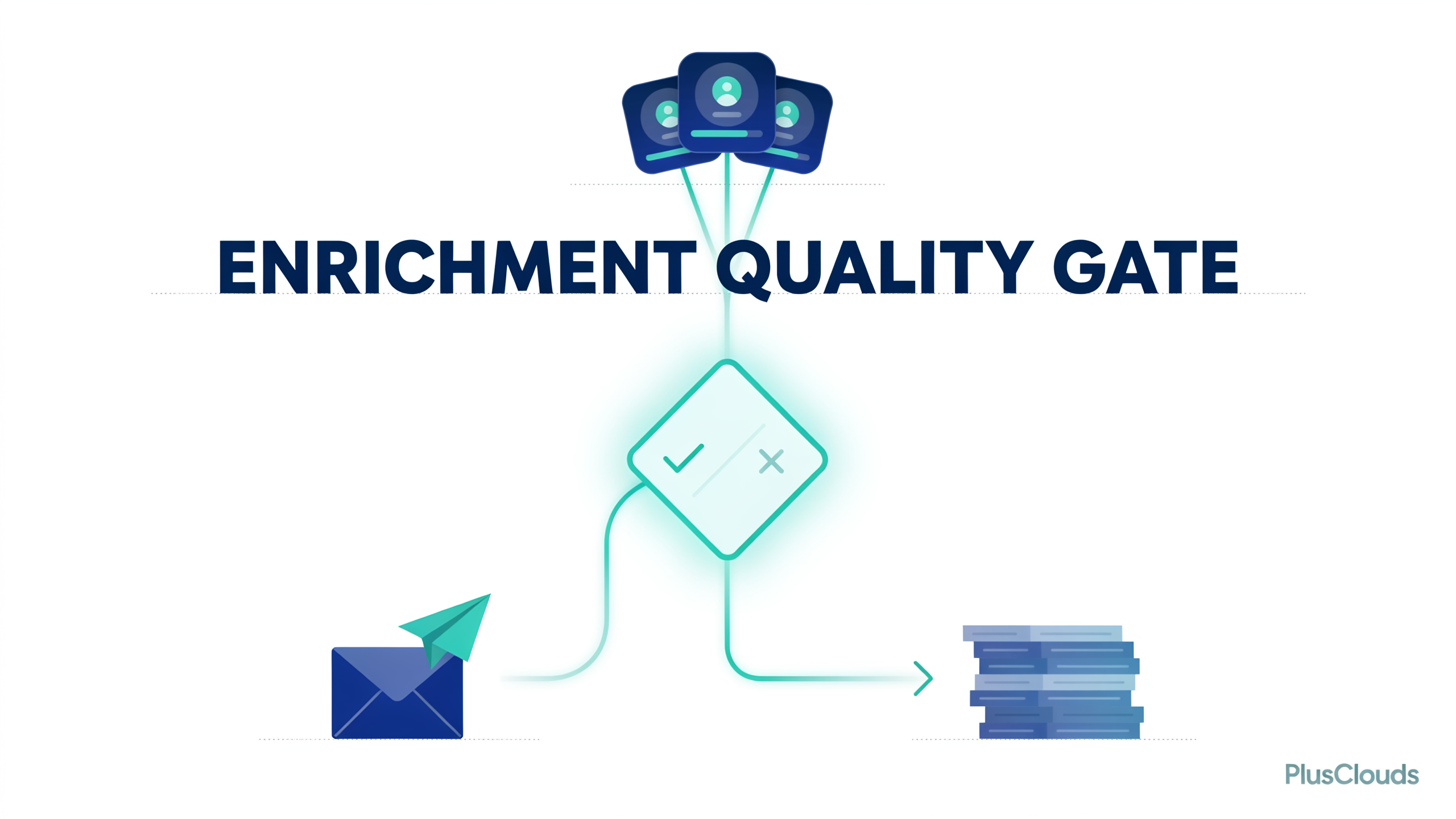
This stage is the least glamorous and the most consequential. Outreach to a bounced email address costs you the account, not just the email.
Every account that passes stage two needs three things attached before sequencing:
- A verified decision-maker contact. Not "head of marketing at company X" but a named person with a title that matches your buyer persona, at a validated email address.
- Research context. Recent company news, the tech stack in place, the signal that triggered entry into the loop. This is the raw material personalization draws on in stage four.
- A quality gate. A rule that decides whether the record is good enough to sequence. A common setup: require a verified email plus at least two research data points. Records that fail go to a review queue rather than into outreach.
The verification step deserves emphasis. Email verification services typically report bounce rates under 2% for verified lists versus 10% or higher for unverified ones, and sending volume with high bounce rates damages your domain reputation across every sequence you run. Build the gate before you scale volume, not after your first deliverability crisis.
The human gap this closes: enrichment debt. When reps research accounts by hand, they skip steps under quota pressure, sequence half-verified contacts, and burn domain reputation. An agent never gets tired at 4 PM on a Friday.
Stage 4: Personalized Sequence Execution, How Eaglet Writes and Fires Multichannel Outreach Automatically
Now the loop goes live. Eaglet by PlusClouds takes each qualified record from stage three and executes the outreach: it drafts personalized messages grounded in the research context, fires them across channels on a defined cadence, and handles replies and follow-ups according to your rules.
Three configuration decisions determine whether this stage produces replies or unsubscribes.
Personalization depth per tier. Match effort to signal strength. A Tier 1 account that visited your pricing page yesterday gets a first line referencing that visit and the specific problem it implies. A Tier 3 nurture account gets a lighter-touch message anchored on industry context. Eaglet draws the first-line material from the enrichment data attached in stage three, so the quality gate you set there directly caps how good your personalization can be.
Channel sequencing. Email alone is a shrinking channel; reply rates improve materially when email, LinkedIn, and phone touches are coordinated instead of fired independently. A typical cadence for a Tier 1 account:
Day 1:  personalized email (signal-referenced first line)
Day 3:  LinkedIn connection request with note
Day 5:  follow-up email (new angle, not "just bumping this")
Day 8:  LinkedIn message after accept
Day 11: phone call + voicemail script
Day 14: breakup email
We mapped the full multichannel design, including channel-specific message structures, in The Omnichannel Outreach Engine.
Escalation rules. Define exactly when a human enters the loop: a positive reply, a meeting request, an objection about pricing or security, or anything matching a do-not-contact pattern. Everything else, including non-replies and soft objections, the agent handles. Get this boundary wrong in either direction and you either lose deals to slow follow-up or burn rep hours on "not interested."
One compliance note before you scale this stage: automated outreach to European buyers carries GDPR obligations around lawful basis, data minimization, and opt-out handling. We covered the practical setup in GDPR-Compliant AI Outreach in Practice, and it is worth reading before your first EU sequence, not after.
The human gap this closes: personalization at scale. Humans cannot write a researched first line for 60 accounts a day. Agents can, provided stages one through three fed them clean data.
Stage 5: CRM Sync and Loop Closure, Auto-Updating HubSpot and Salesforce Without Manual Entry
The final stage closes two loops at once.
The first loop is administrative: every touch, reply, and status change writes back to HubSpot or Salesforce automatically. Sequence stage, last contact date, reply sentiment, and meeting outcomes land on the contact and account records without anyone typing. This matters beyond hygiene. If your CRM only reflects what reps remember to log, your forecasting is built on memory, and memory is worse than you think.
The second loop is strategic: closed-won and closed-lost outcomes flow back into stage one. Deals you win become training signal for your match criteria; deals you lose at a specific stage flag a mismatch between your targeting and your actual buyer. Over a quarter, the loop tightens your ICP without a quarterly strategy offsite.
Practical setup notes:
- Map LeadOcean and Eaglet fields to CRM properties before the first sync runs, not after. Decide now which system is authoritative for each field.
- Sync status changes, not just new records. A contact moving from "in sequence" to "replied" should update the CRM within minutes, because that timestamp drives your speed-to-lead metrics.
- Build a dead-letter queue for sync failures. When a record fails to write, it needs a place to go and a person who sees it weekly.
The human gap this closes: CRM decay. Manual logging dies within weeks of any quota push. Automatic sync does not.
How to Measure the Workflow: The Four Metrics That Tell You Whether Your Agentic Loop Is Actually Working
An autonomous loop without measurement is just automation theater. Four metrics cut through it.
1. Signal-to-contact latency. Time from signal detection to first outreach touch. This is the metric the whole architecture exists to compress. Manual teams run 24 to 72 hours; a working agentic loop should run under four for Tier 1 signals. If this number creeps up, look for queue bottlenecks at stage three.
2. Verified-contact rate. The percentage of sequenced contacts with a verified email and complete research context. Target above 95%. Below that, your stage-three quality gate is too loose, and you are paying for it in bounces and dead personalization.
3. Reply rate by signal tier. Segment reply rates by the tier that triggered the sequence. Tier 1 sequences should outperform Tier 3 by a wide margin; if they do not, your tier definitions are wrong, not your copy. Signal-based outbound programs built this way have reached reply rates around 18%, which we documented in Signal-First Outbound.
4. CRM completeness. The share of outreach activity present in the CRM within one hour of occurring. With automatic sync this should sit near 100%, and any drop is an integration failure, not a behavior problem.
Review all four weekly for the first month after launch, then biweekly. Resist the urge to add metrics. These four cover speed, quality, effectiveness, and data integrity, and every other number in your funnel is downstream of them.
Assembling Your Autonomous Prospecting Loop
The gap in 2026 is not between companies that use AI and companies that do not. It is between companies with five disconnected tools and five human handoffs, and companies running one loop where each stage hands off to the next without waiting for a person to notice. The five stages above, identification, signal detection, enrichment, execution, and CRM closure, are the wiring diagram for the second kind of company.
If you are ready to assemble that loop, start with the two pieces that cover the most ground: LeadOcean builds and refreshes your target queue and detects the buying signals that trigger action, and Eaglet by PlusClouds executes the personalized multichannel sequences and syncs every outcome back to your CRM. You can explore LeadOcean and Eaglet to see how they fit into your existing stack, and run your first fully autonomous prospecting loop this week rather than next quarter.