Your pipeline review is on Thursday. You open the CRM, sort by last activity date, and there it is: a wall of opportunities that haven't moved in 21, 30, 45 days. Nobody said no. Nobody said yes. They just stopped replying. Your reps call it "nurturing." Your forecast calls it revenue. Both are wrong.
This is not a motivation problem. It is a visibility problem. The majority of B2B pipeline doesn't die from rejection; it dies from silence, and silence is invisible until someone manually checks activity logs weeks later. Industry analysis consistently shows that 40 to 60 percent of B2B pipeline is lost to "no decision" outcomes, and research cited by Spuriq's stalled-deals glossary puts the share of B2B buyers who experience a stalled deal in a given year at 86 to 89 percent. Your buyers are stalling. Your process finds out too late.
This guide treats stall diagnosis as the core problem: which stages stall, why, how to detect the risk before the stage goes silent, and how to build a response workflow using LeadOcean buying signals and Eaglet outreach that re-engages deals before they rot.
Key takeaways
- 40 to 60 percent of B2B pipeline dies at "no decision," and 86 to 89 percent of buyers experience a stalled deal in a given year.
- Stalls follow predictable patterns by stage: discovery, evaluation, and late stage each fail in characteristic ways.
- External buying signals (job postings, funding events, pricing-page visits) reveal stall risk that CRM activity logs cannot.
- A stall-rescue playbook with stage-based thresholds, signal tiers, and automated Eaglet sequences can re-book a meeting in under 48 hours.
- Four metrics prove the program works: stall-to-rescue rate, stage dwell time, no-decision loss rate, and signal-to-intervention latency.
Table of Contents
- Why 40-60% of B2B Pipeline Dies at No-Decision, and Why Volume Isn't the Fix
- The Three Deal-Stage Stall Patterns and What Each Signals About Buyer Intent
- How LeadOcean Buying Signals Surface Stall Risk Before a Stage Goes Silent
- Mapping Signal Types to Stage: Which Triggers Matter at Discovery, Evaluation, and Late Stage
- Building a Stall-Response Playbook: From Signal Detection to Coordinated Eaglet Outreach
- How to Wire LeadOcean and HubSpot/Salesforce So Stalls Trigger Automatic Interventions
- Measuring Pipeline Velocity: The Four Metrics That Tell You Whether Your Signals Are Working
- A Real-World Workflow: From Signal Alert to Re-Booked Meeting in Under 48 Hours
- Frequently Asked Questions
- The Pipeline You Already Have Is the Cheapest Revenue Available
Why 40-60% of B2B Pipeline Dies at No-Decision, and Why Volume Isn't the Fix
The instinctive response to a leaky pipeline is to pour more into the top. More SDRs, more sequences, more list pulls. But if 40 to 60 percent of what enters the funnel exits through "no decision," you are refilling a bucket with a hole in the bottom, and the hole grows with volume because every additional deal competes for the same finite rep attention.
The no-decision loss happens for structural reasons, not skill reasons:
- Committee diffusion. The champion who loved your demo changed priorities, got reorganized, or simply lost the internal argument. Nobody notifies you.
- Budget timing. The evaluation was real, but the fiscal window closed. The deal sits in "next quarter" limbo until it quietly ages out.
- Status quo gravity. As Salesloft's analysis of B2B buying signals notes, buyers spend most of their journey in internal evaluation you cannot see. When that evaluation stalls internally, your CRM shows nothing.
The fix is not more pipeline. It is faster detection of the deals already dying in it. A deal you rescue at day 20 is worth more than three new leads you create at day 45, because the rescued deal already has context, stakeholders, and an established problem definition. This is the core of B2B sales acceleration in 2026: diagnose before you generate.
The Three Deal-Stage Stall Patterns and What Each Signals About Buyer Intent
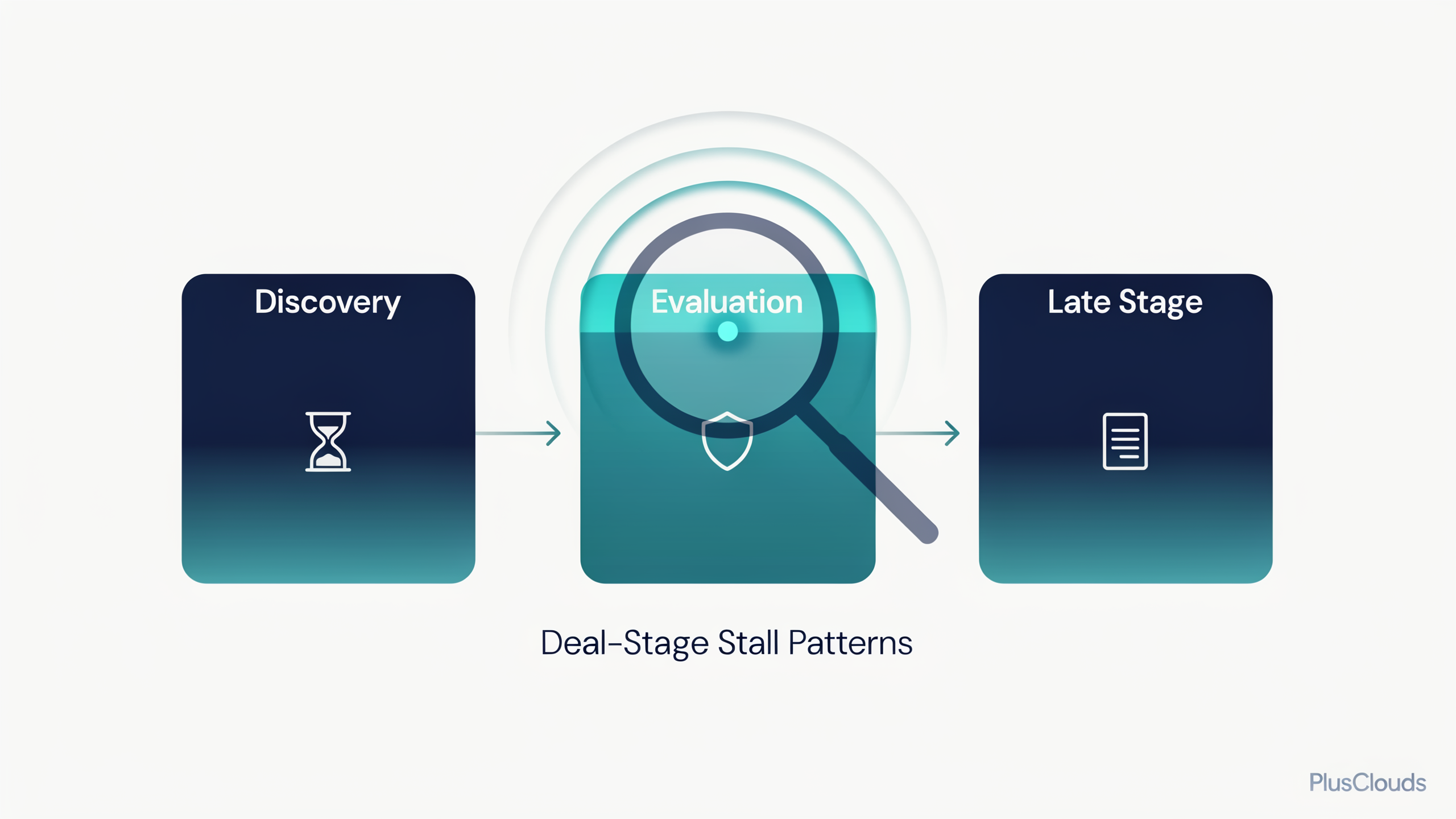
Stalls are not uniform. Each stage fails in a characteristic way, and the failure mode tells you what the buyer is actually doing.
Discovery stalls (days 0 to 14 of an active cycle) look like a champion who booked the meeting, attended, went positive, then went quiet before the second call. This usually signals weak internal urgency: the problem is real but not painful enough yet. The buyer has not built a business case.
Evaluation stalls (mid-funnel, technical and security review) look like completed demos, shared security questionnaires, and then a POC that never gets scheduled. This is the most common and most dangerous stall, because the deal looks healthy in stage-based reporting. It usually means a competitor entered, or an internal blocker (security, procurement, a skeptical stakeholder) appeared and your champion is stuck fighting it alone.
Late-stage stalls (proposal sent, contract in legal) look like redlines that stopped arriving and a procurement contact who stopped answering. This one is often benign: legal queues, end-of-quarter congestion. But it can also signal a re-competition or budget cut, and the cost of assuming "benign" is high.
The diagnostic question for each pattern is the same: what is the buyer doing right now that we cannot see? Which brings us to the actual mechanism.
How LeadOcean Buying Signals Surface Stall Risk Before a Stage Goes Silent
Here is the counterintuitive part: your best early-warning system for stalled pipeline is not inside your CRM. It is outside it. When a deal goes quiet on email and calls, the buyer's company does not go quiet on the internet. They keep researching, hiring, funding, publishing, and visiting vendor sites. That external activity is the stall diagnosis you cannot get from activity logs.
LeadOcean detects buying signals across 1.8B+ companies: job postings that indicate tooling gaps, technology-stack changes, funding events, leadership changes, and website engagement. When you sync your open opportunities into LeadOcean via its native HubSpot and Salesforce integration, every open account gets continuously monitored for signal activity. A deal with zero rep touches in 18 days but a fresh round of engineering job postings and renewed visits to your pricing page is not dead. It is evaluating silently, and LeadOcean is the system that tells you so.
This inverts the usual stall logic. Instead of "no activity in CRM equals risk," you get "CRM silence plus external signal activity equals a live deal that needs a different touch." The deals that show neither CRM activity nor external signals are the ones to deprioritize honestly. That triage alone recovers rep hours that would otherwise be spent leaving voicemails for accounts that have genuinely moved on.
We covered the signal-detection foundation in depth in our first-party intent stack guide; this article applies the same signal layer to existing pipeline rather than new prospects.
Mapping Signal Types to Stage: Which Triggers Matter at Discovery, Evaluation, and Late Stage
Not every signal matters at every stage. Wiring the wrong trigger to the wrong stage produces noise, and noise kills adoption faster than silence does.
| Stage | High-relevance signals | What they indicate | Response posture |
|---|---|---|---|
| Discovery | Funding events, leadership changes, relevant job postings | New budget or new priorities; urgency is forming | Educational content, business-case support |
| Evaluation | Pricing-page visits, competitor tech-stack changes, security/compliance hiring | Active internal comparison; possible blocker | Direct champion enablement, security collateral |
| Late stage | Renewed site engagement, hiring in the department that owns the budget, earnings commentary on spend | Contract review is live or budget re-confirmed | Exec-to-exec touch, commercial flexibility |
Two mapping rules keep this clean. First, evaluation-stage deals deserve the densest signal coverage, because that is where the largest share of no-decision losses occur and where external signals are most predictive. Second, treat any signal on a stalled late-stage deal as urgent regardless of type; at that point the buyer has done the work, and renewed activity usually means the decision is being finalized with or without you.
Building a Stall-Response Playbook: From Signal Detection to Coordinated Eaglet Outreach
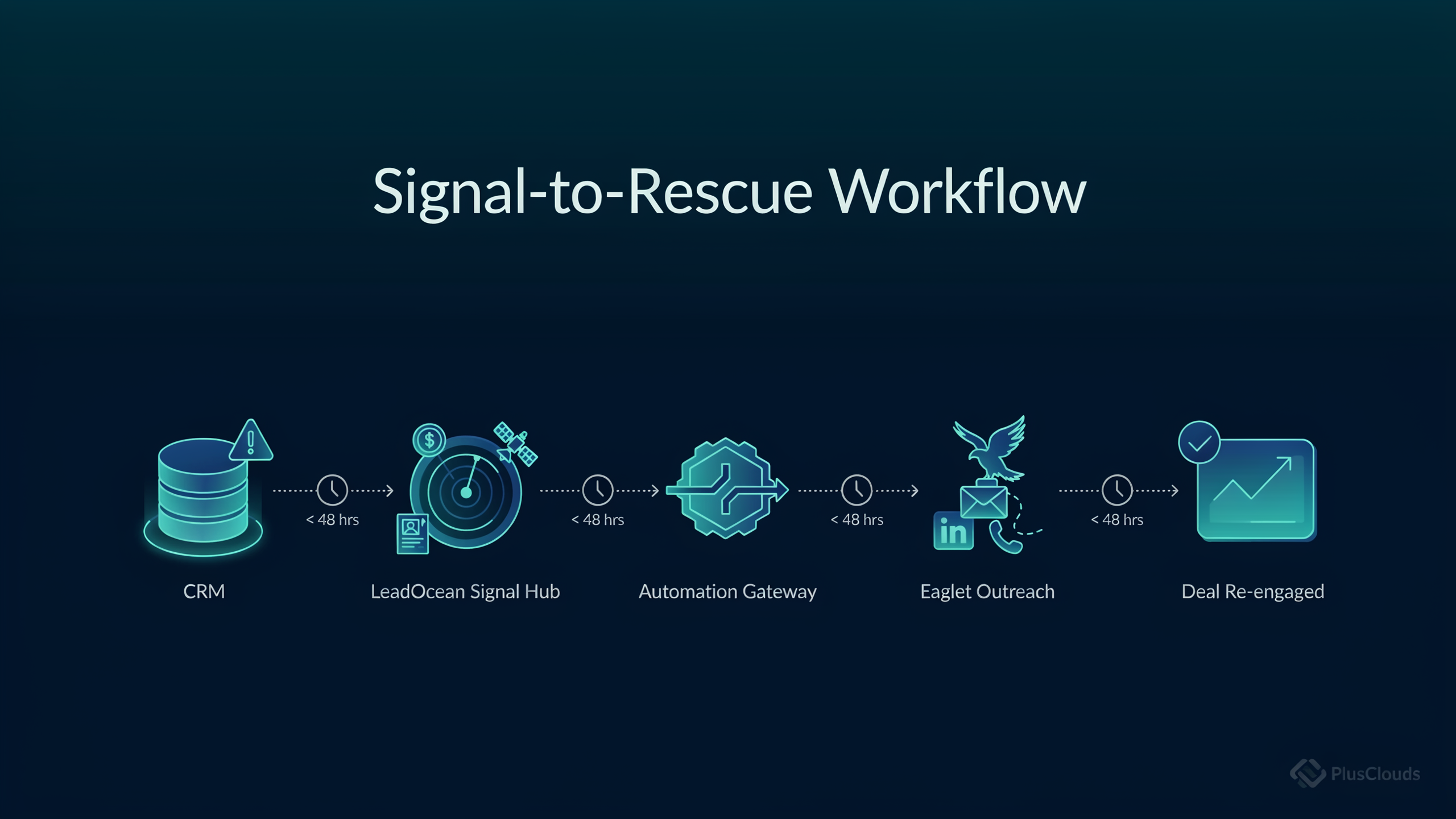
Detection without a response protocol just produces better-informed disappointment. Build the playbook in four steps.
- Define stall thresholds per stage. Discovery: no next step scheduled within 7 days. Evaluation: no champion touch in 10 days. Late stage: no forward motion in 14 days. Write these down; "feels stuck" is not a trigger.
- Assign a signal tier. Tier 1 (pricing visit, funding, competitor displacement): respond within 24 hours. Tier 2 (job posting, leadership change): respond within 72 hours. Tier 3 (general engagement): fold into the next scheduled touch.
- Route to a coordinated sequence, not a single email. A stalled deal needs multi-channel pressure. This is where Eaglet does the heavy lifting: it takes the enriched account context from LeadOcean (the specific signal, the verified decision-maker contacts, the trigger event) and runs a coordinated email, LinkedIn, and phone sequence with AI-personalized messaging anchored to the signal. We documented the full multi-channel architecture in our omnichannel outreach engine guide.
- Change the message frame. Do not "check in." Reference the signal: "Saw you're hiring three platform engineers, which usually means the tooling evaluation is getting serious. Here's the security review packet your team asked about, ready to go." Signal-referenced re-engagement outperforms generic follow-up because it proves you have been paying attention without needing their reply.
How to Wire LeadOcean and HubSpot/Salesforce So Stalls Trigger Automatic Interventions
The playbook above fails if it depends on a rep remembering to check a dashboard. Wire it so the system does the remembering.
The integration path is straightforward. LeadOcean syncs natively with HubSpot and Salesforce, so open opportunities and their associated accounts flow into signal monitoring without CSV exports. From there:
- Create a "Stall Risk" property on the opportunity, computed from last-activity date against your stage thresholds.
- Use LeadOcean's signal webhooks or scheduled sync to write signal events to the account timeline with a signal-type field.
- Build a workflow (HubSpot) or a Process Builder/Flow trigger (Salesforce): when
stall threshold exceeded AND signal tier 1 or 2 fires, create a task for the owner, add the deal to a "Stall Rescue" sequence, and post to the deal's Slack channel if you have one wired. - Suppress the automation when the signal tier is 3 or when the deal has a scheduled next step; the goal is precision, not volume.
A sales-ops person can build this in an afternoon. The result is that every stalled deal with live external intent gets an intervention within hours of the signal firing, with no human checking required. The same signal-to-action logic we described in the 48-hour activation window article applies here, pointed at existing pipeline instead of net-new leads.
Measuring Pipeline Velocity: The Four Metrics That Tell You Whether Your Signals Are Working
You cannot manage the fix without measuring it. Four metrics, reviewed monthly:
- Stall-to-rescue rate. Of deals that crossed a stall threshold, what percentage re-engaged and reached a next step within 14 days? Baseline this before you wire the automation, or you will have no comparison.
- Average stage dwell time. The core pipeline-velocity input. If your evaluation-stage dwell time drops from 34 days to 24 after deployment, the signals are doing their job.
- No-decision loss rate. The headline number. Track closed outcomes by disposition and watch the "no decision" share shrink relative to won and true-lost.
- Signal-to-intervention latency. Time between a Tier 1 signal firing on a stalled deal and the first outreach touch. This is your operational health metric; if it creeps above 24 hours, your automation is leaking.
As the SyncShow 2026 pipeline analysis argues, pipeline health in 2026 is a diagnosis-and-response game, not a volume game. These four metrics are how you prove it internally.
A Real-World Workflow: From Signal Alert to Re-Booked Meeting in Under 48 Hours
Here is the whole system assembled, on a realistic timeline.
Hour 0. A Series B SaaS company's evaluation-stage deal (security review completed, POC pending) crosses its 10-day champion-silence threshold. Simultaneously, LeadOcean fires a Tier 1 signal: the account visited the pricing page twice and posted a role for a "compliance automation lead." The HubSpot workflow creates a Stall Rescue task, enrolls the deal in the rescue sequence, and pings the AE.
Hour 2. The AE opens the LeadOcean record. The AI Match Engine has already resolved the visiting company to the account, surfaced the new compliance hire as a secondary decision-maker with a verified email and LinkedIn URL, and linked the signal to the open POC thread. No research required.
Hour 4. Eaglet launches the coordinated sequence: a signal-referenced email to the champion ("compliance automation hiring usually means the audit timeline is firming up; here's the POC plan we paused, pre-filled"), a LinkedIn touch to the new compliance hire introducing the security documentation, and a call task for the champion the next morning.
Hour 18. The champion replies. The audit deadline moved up; that is why they went quiet. The POC gets re-scheduled for the following Tuesday.
Hour 41. Meeting re-booked. Total elapsed time from silent deal to scheduled next step: under 48 hours, with roughly 20 minutes of human effort.
That is the difference between a pipeline that leaks and a pipeline that self-corrects. The deal was never dead. It was unsupervised, and the signal layer fixed the supervision problem.
Frequently Asked Questions
Can predictive signals really flag a stalled deal before reps notice? Yes, and the mechanism is simple: stalled deals go quiet in your CRM while the buying committee keeps generating external activity. Job postings, funding announcements, leadership changes, and renewed website engagement all precede re-engagement or final decision. LeadOcean monitors these signals across 1.8B+ companies continuously, so a deal with zero rep touches but fresh signal activity gets flagged as live-and-silent rather than dead. Reps typically notice a stall at day 30 or later during pipeline reviews; signal-based detection shortens that to hours.
What is the fastest way to unstick a deal stuck in Evaluation? Reference the signal, not the silence. Pull the most recent Tier 1 or Tier 2 signal on the account, then have Eaglet run a coordinated email, LinkedIn, and phone sequence anchored to that trigger event. The message should remove work from the champion (pre-filled POC plans, ready-to-go security packets) rather than ask for a status update. Deals stall in Evaluation because the champion is fighting an internal battle alone; the fastest unstick is giving them ammunition, not asking how they are doing.
How fast should we respond to a stall signal to actually revive the deal? Within 24 hours for Tier 1 signals (pricing visits, funding events, competitor displacement) and within 72 hours for Tier 2 signals (job postings, leadership changes). The 48-hour window matters because the external activity that fired the signal decays quickly: a buyer who visited your pricing page on Tuesday has a different mental context by Friday. Automation is what makes this speed achievable at scale, since no rep can monitor signal feeds manually across dozens of open opportunities.
Which metrics prove the signal-based rescue program is working? Four: stall-to-rescue rate (percentage of threshold-crossing deals that re-engage within 14 days), average stage dwell time (the core pipeline-velocity input), no-decision loss rate (the headline number this whole system exists to shrink), and signal-to-intervention latency (time from signal fire to first outreach touch). Baseline all four before deployment. If latency stays under 24 hours and dwell time drops within two quarters, the program is working.
Does this replace closed-lost reactivation workflows? No, it complements them. Stall rescue operates on open deals before they formally close; reactivation operates on deals already marked lost. The first is far more valuable because context, stakeholders, and momentum are still intact. Run both, but resource the rescue side first.
Can we run this without a dedicated RevOps person? Yes. The integration is native, the stall thresholds are four numbers, and the workflow automation is a single trigger condition plus three actions. A technically comfortable sales manager can wire it in an afternoon. The ongoing maintenance is reviewing the four metrics monthly and adjusting thresholds once or twice a year.
The Pipeline You Already Have Is the Cheapest Revenue Available
New pipeline costs money and time. Rescued pipeline costs a signal feed and a sequence. The 40 to 60 percent of your funnel dying at no-decision is not a fact of life; it is an unsupervised inventory problem, and supervision is now automatable.
If you want to deploy this, start with LeadOcean connected to your CRM for signal monitoring on open accounts, then layer on Eaglet for the coordinated rescue sequences. Set your stall thresholds this week. The deals currently dying in your pipeline will not wait for next quarter's review to tell you they needed help.