
Your compliance calendar has three colors on it now. Blue for the GDPR review your DPO runs every spring. Green for the NIS2 deadline your security team is chasing. Red for DORA, because your financial-sector customers are demanding contractual assurances whether or not you are technically a financial entity yourself. Three teams, three control frameworks, three evidence repositories, and a growing suspicion that you are testing the same backup restore three times for three different auditors.
That suspicion is correct. Studies of framework overlap consistently show that GDPR, NIS2, and DORA share 60 to 70% of their technical control requirements, yet most organisations run them as parallel programmes, roughly tripling the effort for largely identical outcomes. This article shows you how to collapse those programmes into one control set, one network architecture, and one evidence package that satisfies all three frameworks at once.
Key takeaways
- GDPR, NIS2, and DORA share 60 to 70% of their technical control requirements for cloud infrastructure, so a unified compliance architecture cuts effort by roughly two thirds.
- One ISO 27001:2022-aligned control catalogue with per-framework tags satisfies GDPR Article 32, NIS2 Article 21, and DORA Articles 9 to 12 simultaneously.
- Build backup and restore testing to DORA Article 11/12 depth; NIS2 and GDPR evidence falls out automatically. The reverse does not work.
- Incident detection should be one pipeline with three reporting branches: NIS2's 24-hour early warning, GDPR's 72-hour notification, and DORA's classification-driven clocks.
- Certified infrastructure (ISO 27001, SOC 2, GDPR) shifts roughly a third of your evidence burden to your provider's audit reports.
Table of Contents
- Three Frameworks, One Infrastructure: Why Siloed Compliance Programmes Are Failing in 2026
- Where GDPR, NIS2, and DORA Overlap, and Where They Diverge
- The Unified Control Map: One Set of Infrastructure Controls That Satisfies All Three
- Network Architecture Requirements: Segmentation, DMZ, and VPN Zones as Compliance Evidence
- Backup and Recovery Controls That Satisfy DORA Article 11/12 and NIS2 Business Continuity Simultaneously
- Firewall, WAF, and DDoS Controls as NIS2 Article 21 Technical Measures
- How ISO 27001, SOC 2, and GDPR-Certified Infrastructure Generates Audit Evidence Automatically
- Building the Audit Trail: Logging, Immutable Storage, and Incident-Reporting Workflows
- Your 90-Day Convergence Roadmap: From Scattered Controls to a Single Evidence Package
- Conclusion: One Cloud Infrastructure, One Evidence Package, Three Frameworks
Three Frameworks, One Infrastructure: Why Siloed Compliance Programmes Are Failing in 2026
The problem is structural, not personal. GDPR arrived in 2018 as a data protection regulation. NIS2 entered force in January 2023 with member-state transposition deadlines through October 2024, targeting operational cybersecurity across essential and important entities. DORA applied in January 2025 and governs operational resilience for the financial sector, including many ICT service providers that serve it. Each framework was written by a different Directorate-General, with different vocabulary, different incident-reporting clocks, and different supervisory authorities.
So your organisation built three programmes. The GRC team maps ISO 27001:2022 Annex A controls to GDPR Article 32. The security operations team maintains a separate NIS2 control matrix. The risk function documents DORA Articles 9 through 16 for ICT risk management. Each programme generates its own policies, its own risk registers, its own audit trails.
The failure mode is not just cost. It is drift. When the network team changes a firewall rule, the NIS2 matrix gets updated but the DORA documentation does not, and six months later your evidence contradicts itself across frameworks. Auditors notice this. Supervisory authorities notice this. Inconsistent evidence is worse than incomplete evidence, because it suggests your controls are not actually operating.
The fix is to stop mapping frameworks to controls and start mapping controls to frameworks. Build one infrastructure control set, prove each control once, and tag that evidence against every framework that requires it. The rest of this article shows you what that unified compliance cloud architecture looks like.
Where GDPR, NIS2, and DORA Overlap, and Where They Diverge
Start with the overlap, because that is where your savings live. All three frameworks require, in substance:
- Technical security measures proportionate to risk: GDPR Article 32, NIS2 Article 21, DORA Article 9 all demand encryption, access control, network security, and system resilience.
- Business continuity and recovery: NIS2 Article 21 requires backup management and disaster recovery; DORA Articles 11 and 12 go deeper with restoration and testing requirements; GDPR Article 32(1)(c) explicitly names resilience and recovery.
- Incident handling and reporting: NIS2's 24-hour early warning and 72-hour notification windows, DORA's initial report within 4 hours of classification and intermediate report within 72 hours, and GDPR's 72-hour breach notification to the supervisory authority.
- Supply chain and third-party risk: DORA Article 28 on ICT third-party risk, NIS2 Article 21(2)(d) on supplier security, GDPR Article 28 on processors.
- Logging and accountability: all three expect you to demonstrate that controls operated, not just that they existed on paper.
Where they diverge, the divergence is mostly about who and when, not what. DORA applies to financial entities and their critical ICT providers. NIS2 applies to essential and important entities across 18 sectors, with size thresholds (250 employees or 50 million euros for essential entities, with narrower thresholds for important ones). GDPR applies to anyone processing personal data of EU residents. A single cloud workload can easily sit under all three.
The practical consequence: your encryption configuration does not need three versions. Your incident classification taxonomy does, because the reporting clocks differ, but the underlying detection and logging pipeline is shared. Build once, report thrice.
A useful reference for seeing this convergence mapped in detail is this 2026 analysis of GDPR, NIS2, and DORA compliant cloud architecture, which arrives at the same conclusion from the architecture side: one hardened cloud baseline satisfies the technical requirements of all three.
The Unified Control Map: One Set of Infrastructure Controls That Satisfies All Three
Here is the core exercise. Take your three control matrices and merge them into a single control catalogue where each control carries tags for every framework it serves. A worked example:
| Unified Control | GDPR | NIS2 | DORA |
|---|---|---|---|
| Encryption of data at rest and in transit | Art. 32(1)(a) | Art. 21(2)(h) | Art. 9 |
| Network segmentation and zone isolation | Art. 32(1)(b) | Art. 21(2)(c) | Art. 10 |
| Automated backup with tested restore | Art. 32(1)(c) | Art. 21(2)(c) | Arts. 11, 12 |
| Centralised logging with retention policy | Art. 5(2), 30 | Art. 21(2)(g) | Art. 10(5) |
| Incident detection and classification | Arts. 33, 34 | Art. 23 | Arts. 17 to 20 |
| Third-party ICT risk assessment | Art. 28 | Art. 21(2)(d) | Arts. 28 to 30 |
Twelve to fifteen unified controls typically cover the technical requirements of all three frameworks for a mid-sized organisation. Each control needs one owner, one implementation, one test cycle, and one evidence artefact that is tagged for multiple frameworks.
Two implementation notes that save real pain. First, anchor your unified catalogue to ISO 27001:2022. Since NIS2 Article 21 explicitly recognises international standards as evidence of conformity, and DORA supervisory expectations lean heavily on existing standards, an ISO 27001-aligned control set gives you a neutral spine. If you are weighing certification paths for your cloud business, our comparison of ISO 27001 vs SOC 2 for cloud businesses covers how to use infrastructure itself as audit evidence.
Second, certify the infrastructure layer once and inherit it everywhere. This is where PlusClouds Cloud Security changes the arithmetic: the platform carries ISO 27001, SOC 2, and GDPR compliance at the infrastructure layer, so the firewall, WAF, and DDoS controls you would otherwise document and evidence yourself arrive pre-certified. You still own the application-layer controls, but roughly a third of your evidence burden transfers to your provider's audit reports.
Network Architecture Requirements: Segmentation, DMZ, and VPN Zones as Compliance Evidence
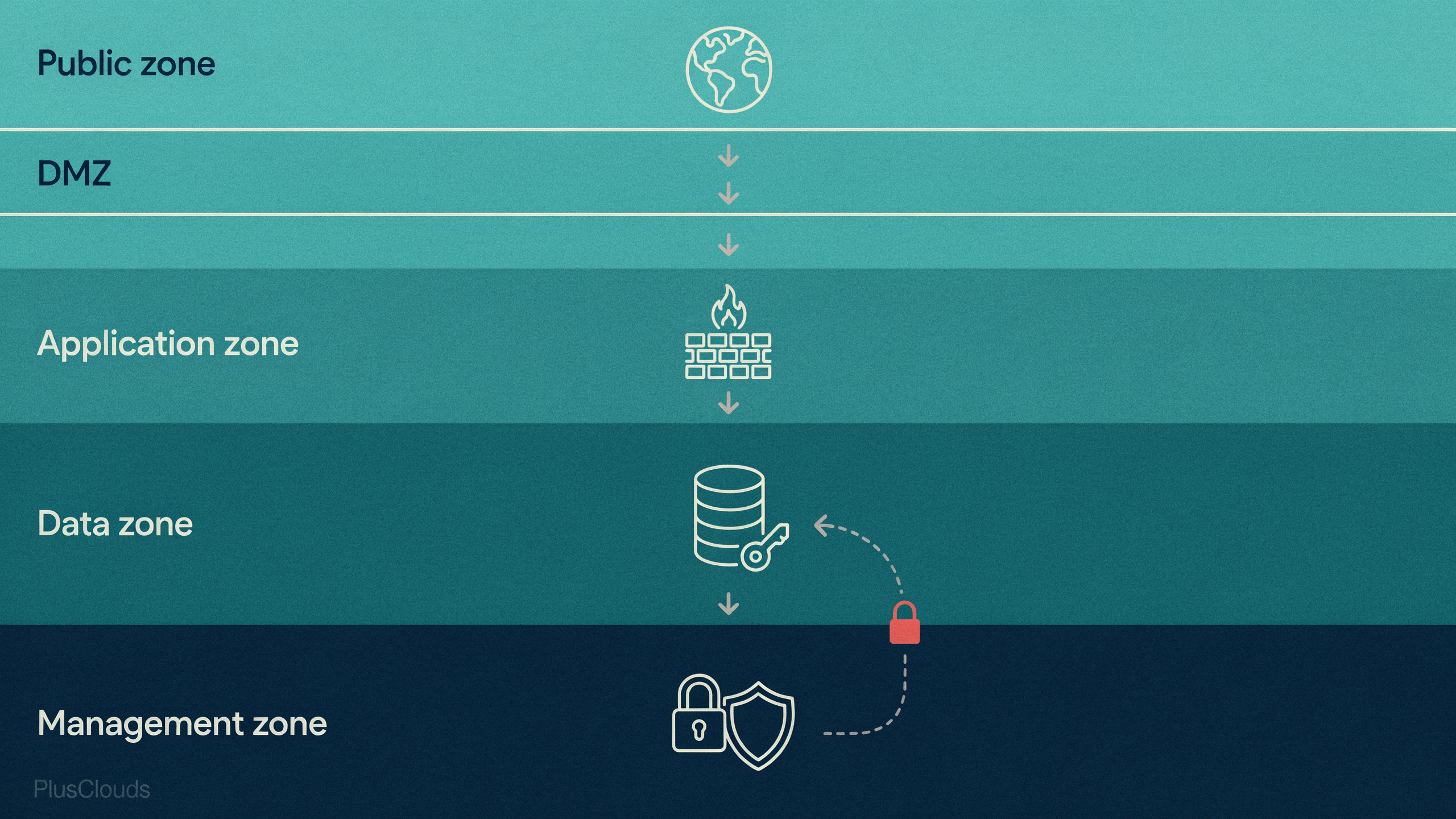
All three frameworks expect network segmentation, but auditors do not accept "we have a firewall." They want a documented zone model, rule sets mapped to that model, and change logs proving the model is enforced.
The zone model that satisfies GDPR, NIS2, and DORA simultaneously has five layers:
- Public zone: internet-facing workloads only, protected by a web application firewall (WAF) and DDoS mitigation.
- DMZ: reverse proxies, load balancers, and API gateways that terminate external traffic.
- Application zone: internal workloads, reachable only from the DMZ and management zone.
- Data zone: databases and storage, reachable only from the application zone.
- Management zone: administrative access via VPN with MFA, fully logged.
This is not exotic architecture. It is the standard five-network model, and PlusClouds' Networking & Load Balancers exposes exactly these five network types (public, private, VPN, management, DMZ) from a single control plane, which means the zone model your compliance documentation describes is the zone model your infrastructure actually enforces. That congruence between documentation and reality is precisely what auditors test.
For evidence generation, capture three artefacts per zone: the network diagram (reviewed quarterly), the firewall rule base with justification per rule, and the change log for rule modifications. When the segmentation question comes up in a PCI context as well, our guide to PCI DSS 4.0.1 firewall, WAF, and segmentation controls shows the same zone model earning evidence across a fourth framework for free.
One decision point deserves attention: tenant isolation. If your workloads handle data with different regulatory sensitivities, multi-tenant virtual machines may be sufficient with proper segmentation, but security-sensitive or financially regulated workloads sometimes warrant single-tenant isolation. Our analysis of multi-tenant cloud versus single-tenant bare metal walks through when the isolation model itself becomes a compliance control.
Backup and Recovery Controls That Satisfy DORA Article 11/12 and NIS2 Business Continuity Simultaneously
Backup is where siloed programmes waste the most duplicated effort, because the underlying technical control is identical and only the documentation depth differs.
The unified control looks like this: automated backups against explicit RPO (recovery point objective) and RTO (recovery time objective) targets per workload tier, stored with the 3-2-1-1 pattern (three copies, two media, one offsite, one immutable), with restore tests executed and documented on a defined schedule.
DORA Articles 11 and 12 add the demanding part: restoration and recovery procedures must be tested, including full failover where warranted, and the results documented as evidence of operational resilience. NIS2 Article 21 asks for backup management and disaster recovery but is satisfied by the same test artefacts. GDPR Article 32(1)(c) asks for resilience and recovery capability, again the same artefacts.
So the design rule is: build the backup programme to DORA's testing depth, and NIS2 and GDPR evidence falls out automatically. The reverse does not work; an NIS2-grade backup programme will fail a DORA supervisory review.
Practically, Automated Backup on PlusClouds handles the mechanics that generate this evidence: scheduled backups with explicit RPO/RTO targets per workload, SLA tracking that shows whether targets were met, and remote restore that lets you execute the recovery tests DORA requires without a manual runbook. Our DORA Article 11 & 12 survival guide details exactly how to design, test, and document these controls to pass a 2026 supervisory review, and our 3-2-1-1 backup rule guide covers the ransomware-resistant storage architecture underneath it, including why the immutable copy matters for both DORA resilience and GDPR availability.
For where the backup copies physically live, data location is itself a compliance control. GDPR data transfer rules and DORA's exit-strategy expectations both care about jurisdiction. Our article on data sovereignty in 2026 covers how to keep workloads inside national borders without sacrificing performance, and PlusClouds Datacenter operations run on Tier 3 facilities with N+1 redundancy, which maps directly to the physical-resilience expectations in all three frameworks.
Firewall, WAF, and DDoS Controls as NIS2 Article 21 Technical Measures
NIS2 Article 21(2) lists the minimum cybersecurity measures, and the network security clause is where your perimeter stack earns its compliance keep. The same stack also evidences GDPR Article 32 and DORA Article 9, so document it once.
Three components, each with a specific compliance role:
- Stateful firewall: enforces the zone model from the previous section. Evidence artefact: the rule base with per-rule justification and the change log.
- WAF: protects application workloads against OWASP Top 10 attack classes. Evidence artefact: WAF policy configuration and blocked-attack logs, which demonstrate the control is operating, not merely installed.
- DDoS mitigation: availability is an explicit compliance requirement, not just an operational one. GDPR Article 32(1)(b) speaks to availability and resilience, and DORA treats ICT disruption as a reportable incident class. Evidence artefact: mitigation event logs showing attacks absorbed without service loss.
The 2026 threat picture makes the DDoS component non-optional. Attackers now run coordinated campaigns across layers 3, 4, and 7 simultaneously, specifically to defeat single-layer mitigation. Our guide to multi-vector DDoS defense in 2026 explains why volumetric and application-layer attacks must be handled by different mechanisms. PlusClouds Cloud Security includes always-on mitigation above 1 Tbps alongside the stateful firewall and OWASP-covering WAF, which means the three perimeter controls arrive as one certified service with one evidence stream rather than three vendors with three audit questionnaires.
How ISO 27001, SOC 2, and GDPR-Certified Infrastructure Generates Audit Evidence Automatically
The shared-responsibility boundary is the concept that makes convergence work. You are responsible for what runs on the infrastructure; the provider is responsible for the infrastructure itself. When the provider's layer is certified, you inherit that evidence through their audit reports instead of generating it yourself.
Map it out for your three frameworks:
- Inherited evidence: physical security at the datacenter, hypervisor isolation, platform-level encryption, the certified firewall/WAF/DDoS stack, backup infrastructure. This arrives via the provider's ISO 27001 certificate, SOC 2 report, and GDPR documentation.
- Shared evidence: network segmentation (provider supplies the zone model, you supply the rule intent), backup execution (provider supplies the mechanism, you supply the RPO/RTO targets and test schedule).
- Your evidence: application security, access governance, incident classification and reporting, vendor assessments of your own downstream suppliers.
For the workloads themselves, PlusClouds Cloud Servers run on AMD EPYC with NVMe storage, deploy in 60 seconds with full root access, and carry a 99.98% uptime SLA with zero egress fees. The root access matters for compliance more than it sounds: you can install your own logging agents, hardening baselines, and file-integrity monitoring without fighting a managed-image policy, while the underlying platform certification still applies. For data-heavy workloads, Cloud Storage provides tiered HDD, SSD, and NVMe pools where you can place backup and archive tiers on the storage class your RPO and retention policies actually require.
The result: your unified control map shrinks from roughly fifteen controls you must fully evidence to perhaps eight, with the remainder inherited or shared. That is the difference between a three-auditor quarter and a one-auditor quarter.
Building the Audit Trail: Logging, Immutable Storage, and Incident-Reporting Workflows
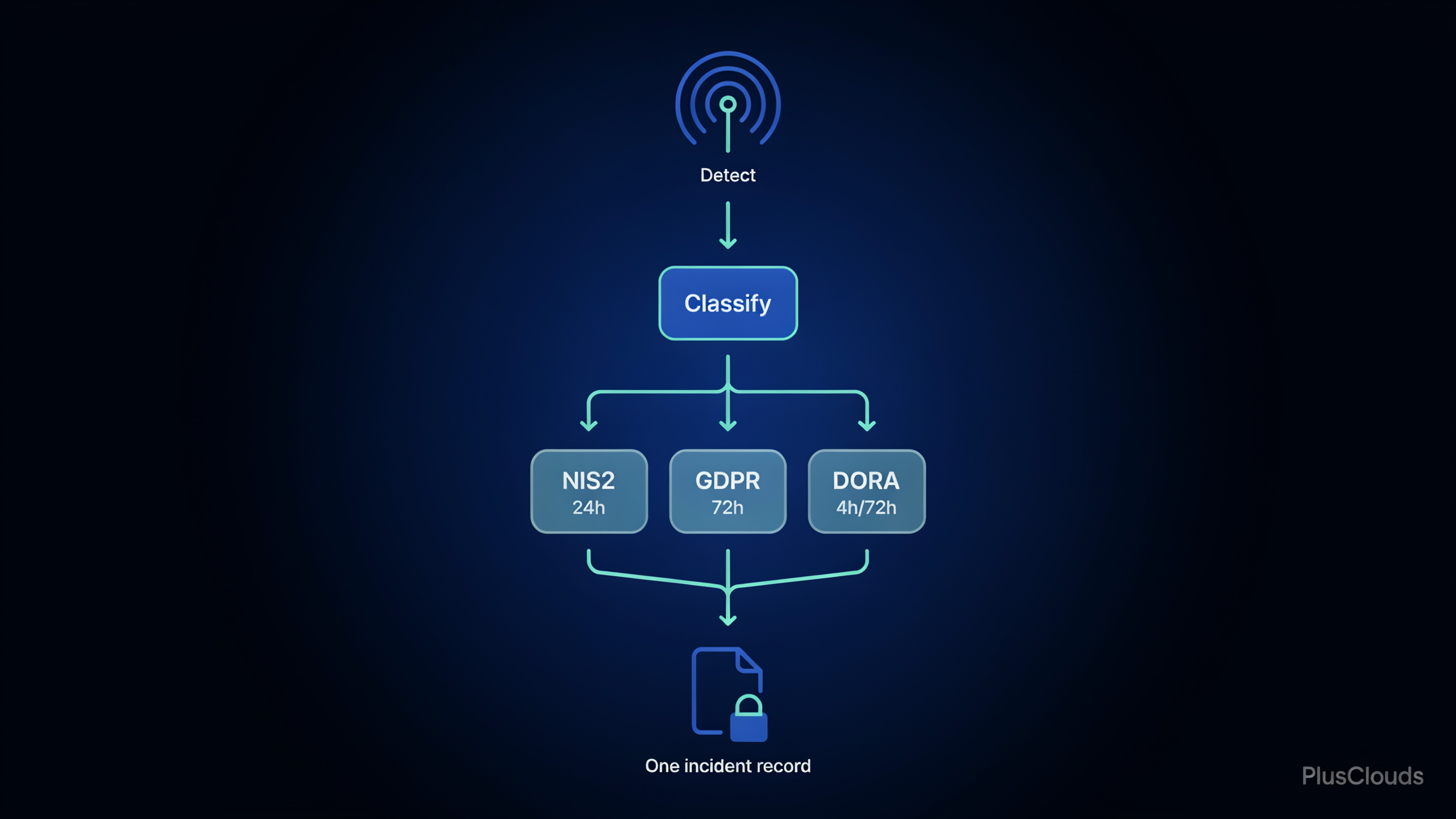
Evidence has a lifecycle, and all three frameworks expect you to prove controls operated over time. Three mechanisms do the heavy lifting.
Centralised logging with defined retention. Ship logs from firewalls, WAFs, servers, and applications to a central store. Retention needs to satisfy the strictest applicable clock: GDPR breach investigations, DORA incident reconstruction, and NIS2 supervisory requests all benefit from at least 12 months of searchable logs. Tag log sources in your control map so a single query answers questions from any auditor.
Immutable storage for backup and log archives. The immutable copy in your 3-2-1-1 pattern serves double duty: it protects against ransomware encryption and it guarantees the auditor that backup evidence has not been altered. Write-once retention settings on the archive tier make this auditable in one screenshot.
One incident workflow, three reporting clocks. This is the one place where convergence requires genuine design work rather than consolidation. Build a single detection-to-classification pipeline, then branch at the reporting step:
- Detect and classify against a unified severity taxonomy.
- At classification, a rules engine determines which frameworks apply to the affected data and systems.
- The workflow fires the correct notifications on the correct clocks: NIS2 early warning within 24 hours, GDPR notification within 72 hours, DORA initial report within its classification-driven windows.
- One incident record carries all three reporting trails, so the evidence is consistent by construction.
Run this workflow as code where possible. A simple script that takes incident classification and outputs the notification matrix removes the single biggest human error point in multi-framework reporting.
Your 90-Day Convergence Roadmap: From Scattered Controls to a Single Evidence Package
Ninety days is realistic if your controls already exist and the work is consolidation rather than construction. The sequence matters: map first, merge second, automate third.
Days 1 to 30: Map. Inventory every control in your three existing programmes. Merge duplicates into the unified catalogue described above, tag each control with its GDPR, NIS2, and DORA references, and assign a single owner per control. Expect to find that 60 to 70% of controls collapse into single entries. Output: one control map, one owner list.
Days 31 to 60: Merge and gap-fill. Consolidate policies into one information security policy set with framework-specific annexes rather than three parallel documents. Run a gap analysis against the unified catalogue. The gaps you will typically find: restore testing at DORA depth, immutable backup copies, and incident workflows with multi-framework reporting clocks. Fix the gaps at the infrastructure layer where you can, because provider-certified controls close gaps faster than home-built ones.
Days 61 to 90: Automate and rehearse. Wire logging to the central store, enable immutable retention on backup archives, script the incident notification matrix, and execute one full restore test documented to DORA standard. Then run a tabletop: pick a hypothetical incident and walk it through the reporting workflow for all three frameworks simultaneously. The tabletop output is your first unified evidence artefact.
At the end of the 90 days you hold a single control map, a single policy set, a single evidence repository, and a tested incident workflow. When the next auditor arrives, whichever framework they arrive under, you hand them the same package with a different cover page.
Conclusion: One Cloud Infrastructure, One Evidence Package, Three Frameworks
GDPR, NIS2, and DORA do not require three compliance programmes. They require one set of infrastructure controls, documented once at the depth of the strictest framework, with reporting workflows that branch only where the legal clocks genuinely differ. Build the control map, anchor it to ISO 27001:2022, and inherit what your infrastructure provider has already certified.
If you want to see how much of your evidence burden transfers to the platform, PlusClouds Cloud Security pairs ISO 27001, SOC 2, and GDPR-certified infrastructure with the firewall, WAF, and DDoS controls all three frameworks demand, and Automated Backup generates the DORA-grade restore evidence for you. Book a walkthrough against your current control map and count how many rows disappear.